
The General Requirements Bulletin (GRB) is an essential guide for anyone aiming to become a registered Patent Agent or Patent Attorney in the United States. Published by the USPTO Office of Enrollment and Discipline
(OED), the GRB provides detailed instructions to navigate the Patent Bar registration process successfully.
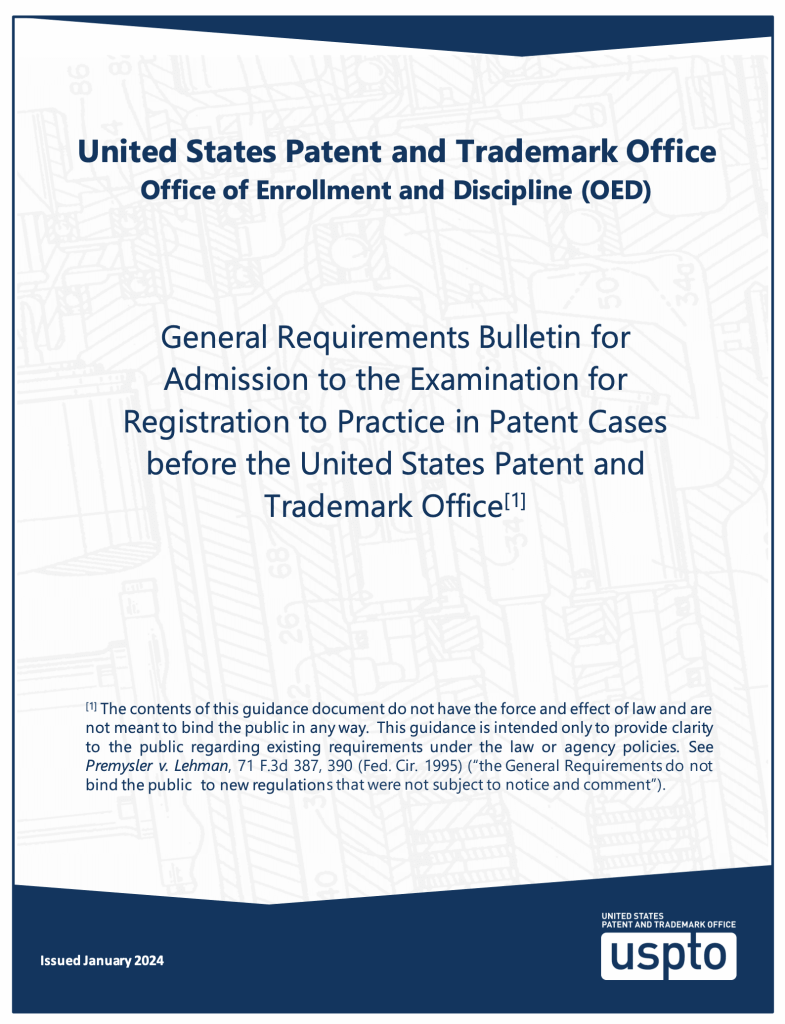
The GRB ensures you understand all requirements and provides essential guidance to help you achieve USPTO registration and advance your career in patent law.
The USPTO General Requirements Bulletin (GRB) is your complete guide to understanding the registration process for the Patent Bar Exam. It covers everything from eligibility and application steps to exam structure and post-exam procedures.
Registration to practice in patent matters is governed by 37 CFR §§ 11.5–11.9 and 11.16, covering:
The USPTO Director ensures that all patent practitioners have the necessary qualifications to provide valuable advice and assistance to applicants (35 U.S.C. § 2(b)(2)(D)).
The USPTO’s primary responsibility is to protect the public from unqualified practitioners (Hsuan-Yeh Chang v. Kappos, 890 F. Supp. 2d 110, 116-17).
You must meet legal, scientific, and technical qualifications to be registered (37 CFR § 11.7(a)(2)(ii)).
All candidates must demonstrate basic scientific and technical training as required under 37 CFR § 11.7(b)(1)(i)(C).
Certain former USPTO employees, including patent examiners, may qualify for a waiver of the Patent Bar Exam under 37 CFR § 11.7(d), depending on their service history.
Regardless of waiver eligibility, all former USPTO employees must meet the scientific and technical training requirements to register as a patent practitioner.
If you are applying for a waiver of the Patent Bar Exam as a former USPTO employee, you must submit the following:
To qualify for the Patent Bar Exam, you must demonstrate that you have the scientific and technical training necessary to provide meaningful service to patent applicants. This is verified by the USPTO Office of Enrollment and Discipline (OED).
You can meet Category A by submitting an official transcript showing a Bachelor’s, Master’s, or Doctorate (Ph.D.) in a technical field from a U.S. or foreign accredited university.
Aeronautical, Aerospace, Agricultural, Bioengineering, Biomedical, Chemical, Civil, Computer, Electrical, Electronics, Electrochemical, Environmental, Food, Geological, Industrial, Marine, Materials, Mechanical, Metallurgical, Mining, Nuclear, Ocean, Petroleum, Textile
Biology, Biochemistry, Biophysics, Botany, Computer Science*, Environmental Science, Genetics, Genetic Engineering, General Chemistry, Molecular Biology, Microbiology, Neuroscience, Pharmacology, Physics, Physics (Engineering Physics)
Electronics Technology, Marine Technology, Materials Science, Textile Technology
Computer Science must be a B.S. from an accredited school.
If you have a degree in a subject not listed above (e.g., Pharmacy, Mechanical Technology, non accredited Computer Science) you must meet Category B or Category C to be eligible for the Patent Bar.
Applicants with a Bachelor’s, Master’s, or Ph.D. in a subject not listed under Category A must show to the OED Director that they have scientific and technical training equivalent to a degree in a Category A subject from an accredited institution.
To prove equivalence, applicants can meet one of the following four options, or other acceptable training or education, by submitting proper documentation and evidence:
To qualify under Category B, applicants must submit official documentation of their scientific and technical training. The following requirements must be met:
The following types of courses do not count as scientific or technical training:
In short, only courses that provide real scientific or engineering training will be accepted.
Applicants may also qualify based on other scientific or technical expertise, on a case-by-case basis.
To qualify through alternative training, an applicant must show that their background provides equivalent knowledge to a Bachelor’s, Master’s or Ph.D. in a recognized Category A subject.
In short, only courses that provide real scientific or engineering training will be accepted.
It’s up to the applicant to prove their background meets this equivalency.
Education from foreign institutions, military programs, or non- traditional learning environments (e.g., life experience, work-based education) may also be considered, if documented proof shows the coursework is equivalent to an accredited U.S. degree in a Category A subject.
Home study courses are acceptable only if the institution is accredited by the DETC and the coursework is in a Category A discipline.
If your education was completed outside the United States, you must have your academic credentials evaluated by a recognized credential evaluation service. The evaluation must confirm that your foreign education is equivalent to a U.S. degree from an accredited institution. The Council for Higher Education Accreditation (CHEA) can provide guidance and a list of recognized evaluators.
Credits earned through the USDA Graduate School—or other similar institutions—may be accepted if they are recognized by an accredited college or university as equivalent to standard coursework.
The USPTO Office of Enrollment and Discipline (OED) does not grant credit for military service, but you can receive credit for technical courses completed as part of military training.
You must provide evidence that these courses would count for college- level semester credits toward a degree at an accredited U.S. university.
Check out the Guide to the Evaluation of Educational Experiences in the Armed Services from the American Council on Education, Military Evaluation Program, One Dupont Circle, Washington, DC 20036-1193.
If you don’t meet the requirements of Category A or Category B, you can qualify by showing practical scientific or engineering experience. To do so, you must take and pass the Fundamentals of Engineering (FE) Exam.
Contact your State Board of Engineering Examiners for information on registration and testing.
If you have a design discipline degree you can qualify to practice only in design patent cases before the USPTO.
You must provide an official transcript—with the university’s seal or stamp—showing your degree. Photocopies, diplomas, or unofficial transcripts are not accepted.
Foreign degrees are accepted if the transcript shows equivalency to one of the approved U.S. design fields.
Once you pass the exam you will be registered for design patent matters only.
All correspondence with the USPTO Office of Enrollment and Discipline must be in writing. No personal visits are required. The OED’s decisions are based only on the written record submitted. (See 37 CFR § 1.2).
Applicants who are not U.S. citizens and do not reside in the United States are generally not eligible to register, except as provided in 37 CFR § 11.6(c).
Currently only practitioners recognized by the Canadian Intellectual Property Office (CIPO) have reciprocal privileges with the USPTO.
Permanent residents (green card holders) can register full.
Applicants who are not permanent residents but legally reside in the U.S. can register under 37 CFR § 11.9(b).
Your documents must show that U.S. immigration has approved your employment or training specifically to represent patent applicants before the USPTO.
Applicants under 8 CFR § 274a.12(b) or (c) are not fully registered after passing the exam; instead they are limited registered consistent with their immigration status.
Documentation to support limited registration must be submitted with your application.
Under 37 CFR § 11.1, “conviction” means any admission of guilt, guilty verdict, judgment of guilt, plea (including nolo contendere or Alford pleas), or deferred adjudication—regardless of whether a sentence was entered.
An individual who has been convicted of a felony or a crime involving moral turpitude or breach of trust cannot apply for registration or be registered
with the USPTO while serving any part of their sentence, probation, parole or deferred adjudication. Eligibility is restored two years after the successful completion of all such terms.
Applicants in this category must pay the fees under 37 CFR § 1.21(a)(1)(ii) and 1.21(a)(10) and provide proof of rehabilitation and good conduct. The OED Director determines if the applicant has shown sufficient evidence of reform.
An individual who has been disbarred from the practice of law or another licensed profession—or has voluntarily surrendered a license to avoid disciplinary action—cannot apply for registration for five years from the date of disbarment or resignation.
Those who have been suspended for ethical reasons are not eligible until the suspension period ends.
If an applicant has been disbarred (or suspended) and convicted of a felony or a crime involving moral turpitude or breach of trust, they must meet the requirements of both 37 CFR §§ 11.7(h)(1) and 11.7(h)(4) before reapplying. Each determination by the OED Director requires payment of the fee under 37 CFR § 1.21(a (10).
Any applicant who has been denied registration by the USPTO Director—or by the OED Director—because of lack of good moral character cannot reapply for two years from the date of the decision (unless a shorter period is approved).
Similarly, an applicant who withdraws their application during a moral- character investigation is barred from reapplying for two years from the date of withdrawal.
For fee purposes, a withdrawal during investigation is treated as a formal OED Director determination under 37 CFR § 11.7.
The USPTO registration exam is administered through a computer-based system managed by Prometric, a commercial testing provider. Applicants seeking registration to practice in patent or design-patent matters must submit a complete application package to the Office of Enrollment and Discipline (OED), including all supporting documents and required fees.
Applications must be complete and accurate before submission; incomplete applications will not be reviewed. Applications submitted by fax will not be accepted (see 37 CFR §§ 1.4(e) and 1.6(d)(1)).
Applicants may either apply online through the Exam Applicant Portal or mail their application materials to:
Applicants may submit their registration form either online through the Exam Applicant Portal or by completing a paper version.\
If submitting the paper form, it must be typed or written in permanent ink—pencil entries are not accepted.\
The form must be personally signed by the applicant, as required under 37 CFR § 1.4(e).
Before filling out the application, carefully read the complete application package, the General Requirements Bulletin, and any additional required forms.
Once completed, check everything and keep a copy of all documents submitted.
The application process is continuous, so any information provided must remain current.37 CFR § 1.2 requires all updates to be in writing, signed, and dated—no updates will be accepted by phone, fax or email.
37 CFR § 11.7(c) requires any change (e.g. address, employment, status) to be reported within 30 days of the event.
Each update must reference the question number being updated and include all relevant information.
Applicants must keep their application current until they are registered to practice before the USPTO and should keep copies of all updates.
Enter your full legal name, including first, middle (not just an initial), and last name.
All official correspondence will use this name. Providing incomplete or incorrect names may cause processing delays or rejection.
If requesting reasonable accommodations, check the box provided and attach supporting documents.
Provide your name exactly as it appears on your valid, unexpired government-issued identification, such as a passport, driver’s license, or permanent resident card.
This same ID must be presented on the day of the exam.
If the ID is expired or does not exactly match the name on your application, you will be denied entry to the examination.
Regardless of your employment status—employed, unemployed, or student—you must provide an address where the OED can reach you between 8:30 a.m. and 5:00 p.m. Eastern Time.
If correspondence should be directed to your workplace, include the name and address of the business.
If you are an officer or employee of the U.S. Government (including USPTO employees), you must list your official department, agency address, and business phone number in lines 1b–1g.
Home or alternate business addresses cannot be used.
If you prefer to receive correspondence at home, include your home address on a separate sheet.
State the country of which you are a citizen.
Enter your date of birth in the appropriate format.
Provide your city, state, and country of birth.
If you are not a U.S. citizen, specify your visa classification as currently assigned by U.S. immigration authorities.
If you are a lawful permanent resident, check “Yes” and include copies of both sides of your Permanent Resident Card (Green Card).
If not, check “No.”
If applicable, include your Alien Registration Number issued by U.S. immigration authorities.
Select the appropriate application fee option.
Review 37 CFR §§ 11.7(h) and 11.7(k) to determine if the fee outlined in 37 CFR § 1.21(a)(10) is required.
Failure to pay the correct fee may result in your application being denied.
Applicants undergoing a moral character review under 37 CFR § 11.7(h)(1), § 11.7(h)(4), or § 11.7(k) must pay the fee specified in § 1.21(a)(10) for each determination by the OED Director.
If you are not admitted to the exam due to incomplete documentation or insufficient qualifications, a refund will be issued minus the $110 processing fee.
Applicants who previously received a refund or an adverse moral character decision must resubmit the full fee when reapplying.
If an applicant withdraws during a moral character investigation, it is considered an official determination under 37 CFR § 11.7, requiring repayment of the same fee in future applications.
A separate exam administration fee is charged by Prometric, the official testing vendor.
This fee is in addition to the USPTO’s registration examination fee.
Prometric’s current rates and policies can be found at www.prometric.com.
Mark the box on line 9 if you previously served as a patent examiner or were employed by the United States Patent and Trademark Office (USPTO) and are requesting a waiver of the examination requirement under 37 CFR § 11.7(d).
Select the box on line 10 if you have already passed a prior registration examination. Indicate the exact date on which the examination was passed
in the space provided.
Check this box if you have ever applied for admission to the registration examination, regardless of whether you were approved, denied, or evaluated for qualification. Include the date of your earlier application.
If you were previously registered to practice before the USPTO as a patent attorney or agent, mark the box and list your prior registration number.
Select the box if you are currently an active member in good standing with any court of the United States, or the highest court of a U.S. state or territory. List all courts and your corresponding bar membership number(s). Do not include a certificate of good standing at this stage. Once you pass the examination, you must provide an original certificate of good standing with the official seal from the highest state court in order to complete registration as a patent attorney.
Each question must be answered completely and truthfully. If uncertain how to respond, it is best to err on the side of full disclosure. Instructions for answering and submitting supporting documentation for questions 14 through 21 are found on the application form and outlined below.
Honesty and transparency are critical. Any misrepresentation, omission, or false statement of material fact may result in denial of registration, revocation, or disciplinary action pursuant to 37 CFR §§ 11.7(a)(2)(i), 11.801, 11.804(c), and 11.804(d).
Applicants must also update their responses in writing within 30 days of any event that changes or adds to their previous answers (for example,
criminal charges or other incidents). Failure to provide timely updates can lead to disciplinary measures or loss of eligibility to practice before the USPTO.
When answering questions 14 through 21, if your response requires explanation, include a detailed written statement containing all relevant facts and dates.
If certain documents cannot be obtained, provide evidence showing your attempts to request them, including copies of any responses received.
Incomplete applications—those missing the required information or documents—will be marked incomplete, and applicants will be granted additional time to provide the missing materials before being considered for examination admission.
Indicate the type of registration for which you are applying by checking the appropriate box — either All Patent Matters or Design Patent Matters Only.
List all academic degrees earned and attach official transcripts for each degree to your application. If necessary, also include official course descriptions to verify eligibility.
Sign and date the completed application form before submission.
All required government fees for registration applications must be paid at the time of submission to the United States Patent and Trademark Office (USPTO).
Payments must be made in U.S. dollars and submitted via cashier’s check, certified check, Treasury note, or United States Postal Service (USPS) money order.
Payments made in other forms — such as personal checks, credit cards, or electronic fund transfers — may cause a delay or cancellation of payment until the amount is successfully collected.
All checks or money orders must be made payable to the Director of the USPTO. Cash payments are not accepted.
If credit card details are submitted on any document other than an official USPTO form for credit card payments, the USPTO assumes no responsibility if that information becomes public. Refer to 37 CFR § 1.23(a) and (b) for official payment rules.
Under the section “Other Fee”, write: “Application and Registration Examination fees.”
A $50.00 service charge applies for each returned or refused payment, including checks marked “unpaid” or credit card transactions that are charged back. See 37 CFR § 1.21(m).
If a financial institution refuses payment (e.g., a returned check, declined, or reversed credit card transaction), the applicant will be denied admission to the examination.
If the issue arises after admission, the Office will withdraw the applicant’s admission and notify them of the nonpayment.
In such cases, the applicant will be informed of the outstanding balance and provided with a deadline to make full payment. Admission to the examination will only proceed once all required fees, including the processing fee under 37 CFR § 1.21(m), are fully paid.
If the USPTO discovers after the examination that payment was declined or reversed, and the applicant has already taken and passed the exam, registration will be denied until the outstanding balance and related processing fees are cleared.
If the applicant has any unpaid fees from previous applications under 37 CFR § 1.21(a)(i) and (ii) or § 1.21(m), they will not be allowed to sit for any future examination until all prior debts are paid in full.
If an applicant submitted an application with one check covering both the $110.00 application fee and the $210.00 examination fee, but the check
was returned unpaid, the applicant must include an additional $160.00 in their next application. This includes:
If an applicant was admitted to the commercial examination session before the returned check was discovered (regardless of whether they took the exam), they must pay $370.00 in additional fees. This includes:
Applicants are strongly advised not to close checking or credit accounts until the payment has fully cleared their bank or credit card provider.
There is no deadline to file for the computerized registration examination. Applications are accepted and reviewed year round.
However, if an application is incomplete and not completed within the time allowed, the application will be denied. In that case the applicant must file a new application and pay all fees. Please note that fees from an incomplete application cannot be transferred, deferred or credited towards a future filing.
Applicants are strongly advised to file a complete application to avoid delays or denials.
Applicants are encouraged to collect and review all required documents and supporting materials before filing.
Category B applicants must include course descriptions and any other supporting academic documentation with their filing.
Non-U.S. citizens (aliens) must attach all required immigration and identification documents with their application.
If the Office of Enrollment and Discipline (OED) determines that additional information or documentation is required, the applicant will be notified by letter. The letter will state:
Applicants will have 60 days from the date of the letter to provide the requested materials. If the applicant fails to submit the required information or documents within that time, a new application and new fees must be filed.
All responses to notices of incomplete or insufficient applications must be signed in accordance with 37 CFR § 1.4(e).
If the application remains incomplete or insufficient after review of additional materials, it will be denied. Applicants who do not respond within
the 60-day deadline will also have their application denied.
Upon denial, the OED will issue a written explanation of the decision.
Applicants whose applications are denied will receive a refund of the $210.00 examination fee; however, the $110.00 application fee is non-
refundable.Fees from one application cannot be transferred to another application
For hand delivery or courier services, call 571-272-4097 for the OED’s street address.
Applicants should keep copies of all documents filed with the USPTO in connection with their registration application.
If you would like acknowledgement, you can include a postcard with your return address with your application.
The postcard should:
However please note that the stamped postcard only confirms receipt of the envelope, not every individual document listed.
Applicants are not to contact OED unless they have not received a response within four weeks of submission.
If no response is received after four weeks, the applicant should contact OED immediately.
Requests for extensions of time to take the exam may be made in accordance with 37 CFR § 11.7(b)(4)(ii. Extensions may be requested and granted multiple times without limitation.
Once OED receives an application and processes the fees, the submitted materials — including the application form and all supporting documents — will be reviewed for completeness and for adequacy of the applicant’s scientific and technical background.
If the applicant meets the eligibility criteria and qualifications for the registration exam, OED will issue an admission letter with further instructions for the exam.
If an application is incomplete, the applicant will be notified in writing. The notice will specify which items (e.g. missing fees, transcripts, information or documentation) must be submitted before an evaluation can take place.
An application is considered incomplete if it lacks any of the following: required information on the form, applicable fees, official transcripts or other supporting documents. Once the applicant submits the missing materials, OED will process the application based on the information received.
To have their qualifications reviewed the applicant must pay both the application fee ($110.00) and the exam fee ($210.00).
Each application processed by OED is assigned a USPTO Identification Number (USPTO ID number). This number will be on all official correspondence from OED. Applicants should use their USPTO ID number in all future correspondence with the office.
The USPTO ID number is the applicant’s unique identifier and must be included on all documents and correspondence submitted to OED after it has been issued.
If an applicant disagrees with a denial of their application, they may file a petition to the OED Director according to 37 CFR § 11.2(c). A fee as set forth in 37 CFR § 1.21(a)(5)(i) must be included with the petition.
The petition must include the applicant’s original signature as per 37 CFR § 1.4(e) — faxed copies are not acceptable. All petitions and supporting documents must be filed within 60 days from the date of the notice of disapproval to request reconsideration.
The OED Director will review the petition and issue a written decision. If granted, the applicant will be admitted to the exam or the original decision will be upheld.
If the applicant is still not qualified, the OED Director’s decision will be final. In that case, the $210.00 exam fee will be refunded and $110.00 application fee will not be refunded. Fees from one application cannot be transferred to another.
Any petition filed after 60 days will be dismissed as untimely.
If the OED Director issues a final decision denying an applicant’s admission to the exam, the applicant may request further review by filing a petition to the USPTO Director according to 37 CFR § 11.2(d).
To initiate this review, applicants must file the petition within 30 days of OED Director’s final decision and pay the required fee as set forth in 37 CFR § 1.21(a)(5)(ii).
Any petition filed after 30 days will be dismissed as untimely and no further consideration will be given.
Applicants have three ways to ensure a reply to a notice of incompleteness or disapproval — or a petition — is filed on time. Applicants should consult the relevant provisions of the MPEP and USPTO rules for more information.
First-class mail or hand delivered replies or petitions will be date stamped as received on the date they arrive at the USPTO according to 37 CFR § 1.6.
To meet deadlines, applicants should allow sufficient mailing time so that their documents are received by or before the due date.
Hand deliveries to the Office of Enrollment and Discipline (OED) are accepted during public business hours (8:30 a.m. to 5:00 p.m.).
Applicants may obtain OED’s street address for hand or courier deliveries by calling 571-272-4097.
Applicants may also file a reply under the Certificate of Mailing procedure outlined in 37 CFR § 1.8.
Because the USPTO does not accept facsimile submissions of registration applications, the Certificate of Transmission procedure cannot be used.
Submissions will be considered timely filed under this method if all the requirements of 37 CFR § 1.8 are met.
A sample certificate of mailing is in the appendix of this General Requirements Bulletin.
Applicants may use Priority Mail Express® to submit materials to the USPTO as permitted under 37 CFR § 1.10. In this case, the “date-in” on the Priority Mail Express® mailing label, as recorded by a U.S. Postal Service employee, is the filing date.
So to file on time, applicants must make sure the date-in on the mailing label is on or before the deadline.
A Request for Reasonable Accommodation package (Form PTO 158RA) has been created to help applicants who need accommodations due to a physical or mental medical condition when taking the exam to practice before the USPTO.
Applicants seeking accommodations must complete and submit both sections of this package. Failure to provide the necessary information or documentation may result in the USPTO being unable to evaluate or grant the requested accommodation.
When submitting the Application for Registration (Form PTO 158), applicants should check the box to the right of their name on the application form, indicating that the request is enclosed with the submission.
After the applicant’s admission to the exam, a separate written notice specifying the approved accommodations will be sent to the applicant.
Applicants who are approved to take the commercially administered exam and are granted reasonable accommodations will be given extra time to schedule their exam appointment with Prometric.
The scheduling process may take up to 30 days. Once the OED has issued the official notice confirming the granted accommodation, the applicant must contact the Prometric Reasonable Accommodations Department at 800-967-1139 to schedule the exam.
If an applicant has requested an accommodation but the admission notice does not mention or confirm that request, the applicant should call OED immediately for clarification or assistance.
Applicants must provide clear and concise answers to all questions in the Applicant’s Statement section of Form PTO 158RA. If more space is needed, applicants may attach additional sheets to ensure all answers are complete.
Applicants must also include a completed Licensed Health Care Professional’s Statement and/or other medical documentation to support the request for reasonable accommodation.
The completed accommodation package should be submitted with the Application for Registration (Form PTO 158) to the United States Patent and Trademark Office, Office of Enrollment and Discipline (OED).
For any questions or additional assistance, applicants may contact the Office of Enrollment and Discipline at 571-272-4097.
Applicants who previously received reasonable accommodations for an earlier registration examination must submit a new Applicant’s Statement each time a new Application for Registration (Form PTO 158) is filed.
Depending on the nature of the applicant’s condition, it may also be advisable to provide a new Licensed Health Care Professional’s Statement. The determination of whether an accommodation is warranted—and what type of accommodation is appropriate—depends on an assessment of the current functional impact of the applicant’s medical condition.
For applicants with temporary or variable impairments, a recent medical evaluation is required for the USPTO to accurately assess accommodation needs. However, for applicants with chronic or long-term conditions, a new Licensed Health Care Professional’s Statement may not be necessary, as long as the previous documentation remains relevant and accurately reflects the applicant’s current health status.
The registration examination is designed to evaluate an applicant’s understanding of patent laws, rules, and procedures, as well as the ability to analyze factual scenarios and apply the law accurately to assist clients in the preparation and prosecution of patent applications. 35 U.S.C. § 2(b)(2)(D). The exam may also include questions addressing professional and ethical standards expected of registered patent attorneys and agents.
Before attempting the examination, applicants should familiarize themselves with patent statutes, USPTO rules of practice (Parts 1, 3, 11, 41, and 42 of Title 37 of the Code of Federal Regulations), procedures outlined in the Manual of Patent Examining Procedure (MPEP), and other USPTO policy and procedural guidance. Examination questions are drawn from the MPEP and other official USPTO references. In the event of a discrepancy between these sources and the MPEP, the published USPTO materials will govern.
The OED will issue announcements identifying the date when updated reference materials will be reflected in the examination. Such notices will appear in the Official Gazette and online at:
https://www.uspto.gov/Practitioners. The announcement will specify the MPEP version and other references used for examination questions. All reference materials will be available during the examination.
The exam consists of 100 multiple-choice questions, administered in two separate three-hour sessions: 50 questions in the morning and 50 in the afternoon. Each question has five answer options. Total time is six hours.
No external materials, documents, machines or electronic devices are allowed, including computers, phones, cameras, recording devices or typewriters.
For computer-based exams administered commercially, all reference materials will be on the test computer. Prometric provides secure lockers for storage of items not allowed in the testing area.
For applicants with temporary or variable impairments, a recent medical evaluation is required for the USPTO to accurately assess accommodation needs. However, for applicants with chronic or long-term conditions, a new Licensed Health Care Professional’s Statement may not be necessary, as long as the previous documentation remains relevant and accurately reflects the applicant’s current health status.
MPEP and other USPTO reference materials are online. USPTO, including OED, does not provide individual guidance or instruction on patent laws, rules, policy or procedural practices for exam prep
USPTO does not endorse, recommend or provide guidance on specific courses, training programs or materials for exam prep. Applicants are responsible for determining their own preparation needs.
Official examination results are released by OED and mailed to applicants after the examination date. Applicants who pass the exam will receive further instructions for completing the registration process.
For computer-administered examinations, candidates taking both morning and afternoon sessions on the same day may view unofficial results on the test computer immediately upon completion. Official results will still be mailed subsequently.
Applicants approved for commercial administration of the registration examination will receive an admission letter with instructions for contacting
Prometric to arrange a date and location for the exam. It is essential that the personal information on the admission letter matches exactly the name
provided on line 1b of the application, as this name will be used by Prometric to verify eligibility for entry to the testing site.
The admission letter will provide Prometric’s website and contact number, along with a specific time window to schedule the examination. Once this period expires, the applicant will no longer be able to schedule the exam and must submit a new application along with the required fees.
Applicants may request an extension of the scheduling period for a $115.00 fee, in accordance with 37 C.F.R. § 11.7(b)(4)(ii). Online applicants may submit the request through the Applicant Portal at https://oedci.uspto.gov/OEDCI/. Those who applied offline or prefer to submit by mail or fax may send their request, including the applicant’s name as used on the application and the extension fee. Extensions may be requested and granted an unlimited number of times, provided the request is received before the current scheduling window expires. Requests submitted after the expiration will result in a refund of the fee. Prometric may also charge a separate fee for scheduling or rescheduling the examination.
The OED will issue announcements identifying the date when updated reference materials will be reflected in the examination. Such notices will appear in the Official Gazette and online at:
https://www.uspto.gov/Practitioners. The announcement will specify the MPEP version and other references used for examination questions. All reference materials will be available during the examination.
Prometric collects the examination administration fee from candidates at the time of scheduling. No fees are collected at testing centers. You cannot sit for the exam until payment is received.
Once OED approves you for the exam, you must schedule a test location directly with Prometric and pay the administration fee at the time of scheduling. Instructions will be included in the admission letter or via email. You should schedule your exam as soon as possible as some testing centers fill up quickly. Scheduling late may require you to take the exam at a different location or on a less preferred date
Approved candidates have three ways to schedule the exam:
You should arrive at the test site 30 minutes early to complete check-in. Late arrivals will not be admitted. Policies for late arrival, rescheduling or no-show are on Prometric’s website. Prometric cannot schedule exams outside the testing window assigned by OED.
Exams can be rescheduled online at Prometric.com or by calling the toll- free line for USPTO candidates (1-800-479-6369). If a testing center experiences technical difficulties, emergencies or weather issues, the exam will be rescheduled at no additional cost to the candidate.
Failure to appear for a scheduled exam will result in loss of eligibility at Prometric. If time remains in the testing window, OED may re-activate eligibility; otherwise, you must submit a new application and fees. Candidates who miss their scheduled exam forfeit all USPTO fees paid.
You must bring a current, valid government-issued photo ID (state or federal), such as a driver’s license or passport, which has a photograph and signature. One ID is sufficient. The name on the ID must match exactly the name on line 1b of the application.
Admission will be denied if the name on the photo ID does not match the application or if the ID is not valid at the time of entry. Admission letters are not accepted and no name changes can be made at the testing center.
Do not bring reference materials, study notes or scratch paper into the testing area. All reference materials will be available on the computer during the exam.
Upon arrival, you will sign a log and an electronic photo will be taken. Entry and exit times will be recorded and the signature will be verified against the photo ID.
Prometric’s testing platform is user friendly. A 15-minute tutorial precedes the exam and a 15-minute survey follows the exam. Scratch paper and pencils will be provided; you may not bring your own. All scratch paper will be collected and destroyed after the session.
There is an optional, timed one-hour lunch break; no other breaks are scheduled. Unscheduled breaks can be taken but the exam timer will continue.
Prometric test center staff will be monitoring the area and the room is under video surveillance. Cheating, including copying, photographing or using unauthorized materials will result in immediate removal from the testing center.
You must notify OED and Prometric of any changes to your address or phone number.
You will receive a confirmation from Prometric of your exam date. Keep this for your records.
If you do not pass the exam you may review but cannot copy questions and incorrect answers within 60 days of receiving your exam results.
Reviews are done on a computer at a Prometric test site. Notes or copies of questions are not allowed.One review per exam. Call Prometric at 1-800-479-6369 or go to www.prometric.com or OED: 600 Dulany Street, Madison West, 8th Floor, Alexandria, VA 22313. 571-272-4097
Applicants who fail the examination may reapply 30 days after their last attempt. Eligibility for retesting is managed by OED, not Prometric.
Fees paid in error or in excess will not be refunded. Once an applicant has been approved to take the examination, the registration examination fee will not be refunded, even if the applicant does not attend the examination.
For applicants who have submitted the $1,680.00 fee under 37 CFR § 1.21(a)(10), a refund will be issued less the $110.00 application fee if the applicant is denied admission.
must submit a new application and pay the $110.00 application fee and the applicable registration examination fee to be considered for a future examination.
Similarly, applicants previously denied admission to an examination must also file a new application and pay all applicable fees to reapply.
A petition may be filed under 37 CFR § 11.3 to suspend or waive a regulation—provided it is not a statutory requirement—in extraordinary circumstances where justice requires the waiver.
After passing or receiving a waiver of the registration examination, the OED Director will ask for information about your moral character and reputation (37 CFR § 11.8(a)). If adverse information is received, OED will investigate your character after you pass the examination or get a waiver (37 CFR § 11.7(g)(2)(i)). You will be notified of what to do next.
If you pass the examination but don’t complete the registration or limited recognition process within two years from the date of the notice of passing you must retake and pass the examination (37 CFR §§ 11.8(b) and 11.8(c)).
Information about the registration examination, forms and guidance is available on the OED home page at the USPTO website.
I hereby certify that this correspondence is being deposited with the United States Postal Service with sufficient postage as first-class mail, addressed to
Director of the United States Patent and Trademark Office
P.O. Box 1450
Alexandria, VA 22313-1450
I further certify that I have a reasonable basis to expect that the application and accompanying materials will be mailed on or before the date shown above.
The 1974 Privacy Act (P.L. 93-579) requires that you be given certain information when you submit forms PTO-158 and PTO-275. Here’s what you need to know:
We may disclose the information you provide as follows:
Avenue William St, Melbourne VIC 2400, Australia
Avenue William St, Melbourne VIC 2400, Australia
info@wysebridge.com